
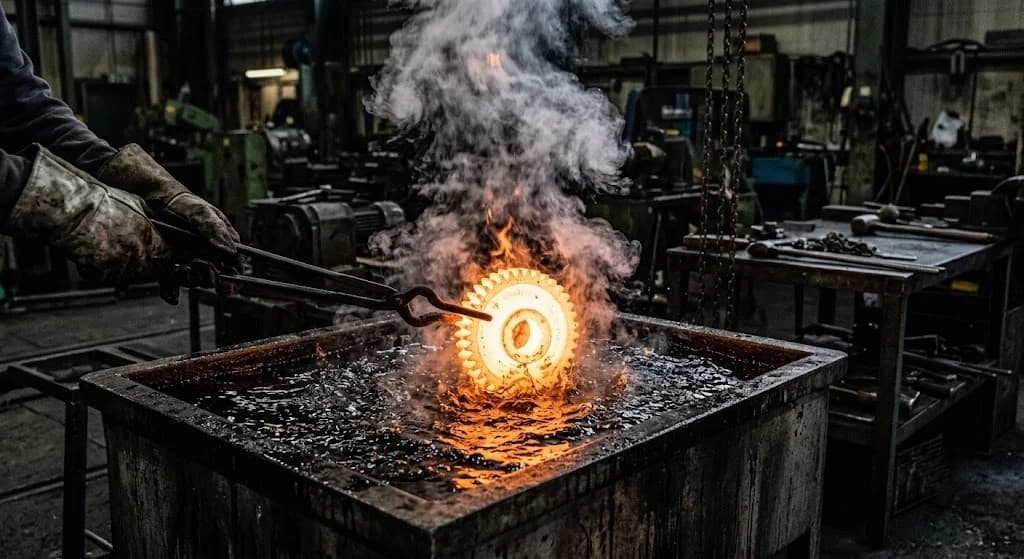
If your part needs to survive wear at the surface but can’t afford to be brittle all the way through, case hardening is almost always the right call over through hardening — and picking the wrong one is one of the more expensive material mistakes we see on incoming drawings.
Quick Summary
- Case hardening builds a hard, wear-resistant layer on the surface of a part while leaving the core soft and tough. Through hardening hardens the entire cross-section uniformly.
- The two main case hardening methods are carburizing (adds carbon, needs a quench) and nitriding (adds nitrogen, doesn’t need a quench and causes far less distortion).
- Typical case depths run 0.010″–0.080″ depending on the process and soak time; surface hardness after carburizing commonly lands in the 58–62 HRC range.
- Low-carbon steels like 1018 and 8620 are built for case hardening — they physically can’t be through hardened because they don’t have enough carbon to form martensite all the way through.
- Case hardening is standard practice for gears, shafts, pins, and cams — anything that needs a wear surface but also needs to bend, flex, or absorb shock without cracking.
What Is Case Hardening?
Case hardening is a heat treatment that hardens only the outer layer, or “case,” of a part while the interior stays soft and ductile. The classic example is a gear tooth: the surface needs to resist wear from constant meshing, but the body of the gear needs enough give to absorb shock loading without snapping.
The process works by changing the surface chemistry of the metal — usually by diffusing carbon or nitrogen into it at high temperature — and then, in most (but not all) methods, quenching it to lock in a hard surface structure called martensite. The core, which never picked up the extra carbon or nitrogen, stays soft.
How Is Case Hardening Different From Through Hardening?
Through hardening changes the entire part uniformly. You heat the whole thing above its critical temperature, quench it, and the full cross-section hardens — assuming the steel has enough carbon to respond that way in the first place. A2 and D2 tool steel, 4340, and O1 are through-hardening steels; you’ll see them called out that way on a print because the hardness spec applies to the whole part, not a surface layer.
| Case Hardening | Through Hardening | |
|---|---|---|
| What hardens | Surface only (a thin case) | Entire cross-section |
| Core condition | Stays soft and tough | Hard and brittle throughout |
| Typical steels | 1018, 8620, 1010 | 4140, 4340, A2, D2, O1 |
| Best for | Gears, shafts, pins — parts needing wear resistance + shock tolerance | Tooling, dies, structural parts needing uniform strength |
| Distortion risk | Lower (especially with nitriding) | Higher, particularly on large or thin sections |
Neither one is “better” in general — they solve different problems. A gear tooth that’s through-hardened and brittle all the way to the core is a gear that cracks under shock load. A die that’s only case hardened won’t hold up to repeated deep impressions once the thin case wears through.
What Are the Main Case Hardening Methods?
Three show up on drawings most often, and they’re not interchangeable:
Carburizing diffuses carbon into the surface at 1,600–1,700°F, then quenches the part to form martensite. It’s the workhorse method — cheap, well understood, and it produces the deepest cases of the three. The tradeoff is distortion: the high heat and quench step can warp thin or asymmetric parts, which is why precision dowel holes and bores sometimes need to be reamed or ground after heat treat rather than before.
Nitriding diffuses nitrogen instead, at a much lower temperature (roughly 925–1050°F) and with no quench step at all. Because there’s no quench, distortion is minimal — parts can often be nitrided in their final machined state. The catch: nitriding needs alloying elements like chromium, aluminum, or vanadium to form the hard nitride compounds, so it doesn’t work on plain low-carbon steel the way carburizing does, and case depths run shallower.
Carbonitriding splits the difference — carbon and nitrogen both diffuse in, at a temperature between the other two. It’s often chosen for plain carbon steels that don’t have enough alloy content to nitride well but still need better hardenability than straight carburizing gives at a shallow case depth.
| Method | Element Added | Needs Quench? | Typical Case Depth | Distortion |
|---|---|---|---|---|
| Carburizing | Carbon | Yes | 0.010″–0.080″+ | Higher |
| Nitriding | Nitrogen | No | 0.002″–0.024″ | Very low |
| Carbonitriding | Carbon + Nitrogen | Yes | 0.005″–0.030″ | Moderate |
How Deep Does the Hardened Case Go?
Effective case depth is measured to a hardness boundary — commonly where the material drops to 50 HRC — and it’s controlled almost entirely by time and temperature at the furnace. Longer soak, deeper case. A light case for a small pin might run 0.010″; a deep case on a large gear tooth can push past 0.060″.
This is worth calling out on a print explicitly, because “case harden this part” without a depth spec leaves the heat treater guessing, and the resulting hardness profile can vary a lot between two shops interpreting the same vague callout differently.
Which Materials Can Be Case Hardened?
Low-carbon steels are the classic candidates — 1018 and 8620 especially, since their low carbon content means they physically can’t through harden but respond well to carburizing. We stock 1018 as a standard steel option and can source 8620 and other alloy grades on request; our steel materials page has the full rundown of what’s available by default.
Stainless steel can be case hardened too, but it’s a narrower conversation — austenitic grades like 304 and 316 don’t carburize the way plain carbon steel does, and low-nickel grades like 201/202 can pick up unwanted magnetism from cold work that complicates things further if magnetic permeability matters for the application. If you’re specifying stainless and need a hardened surface, it’s worth a direct conversation with us before locking in the material callout.
Does Case Hardening Cause Warping?
Carburizing can, particularly on thin sections or parts with big differences in cross-sectional thickness — the quench step is the culprit. Nitriding largely avoids this because there’s no quench at all. If a part has tight-tolerance features like dowel holes or a bore that has to stay round after heat treat, it’s common to leave those features slightly undersized before hardening and finish-ream or grind them afterward, rather than trying to hold final tolerance through the heat cycle.
What Parts Actually Need Case Hardening?
Gears are the textbook case, but the same logic applies to shafts, cam lobes, pins, and any wear surface that also has to flex or absorb impact. If a part’s failure mode under normal use is “the surface wears out,” case hardening is usually the answer. If the failure mode is “the whole part deforms or breaks,” through hardening or a tougher base material is the better fix.
Frequently Asked Questions
Can a case-hardened part be machined afterward? Not effectively on the hardened surface — the case is typically 58–62 HRC, well past what standard tooling handles cleanly. Any finish machining on critical features should happen before hardening, with grinding or reaming reserved for after, if needed.
Is case hardening the same as surface hardening? Yes, they’re used interchangeably. “Surface hardening” is the broader term; case hardening usually implies a diffusion-based method like carburizing or nitriding specifically, as opposed to induction or flame hardening, which harden the surface without changing its chemistry.
How is case depth actually measured? By cutting a cross-section, mounting and polishing it, and running a Vickers or Knoop microhardness traverse from the surface inward until the reading drops to the hardness boundary (commonly 50 HRC-equivalent). It’s a destructive test, so it’s usually done on a sacrificial sample rather than the actual part.
How much more does case hardening cost than through hardening? It depends more on part geometry and case depth than on the process itself. A shallow case on a simple pin is cheap; a deep case with tight distortion control on a complex gear can cost more than a straightforward through-harden, because of the extra masking, fixturing, and post-heat-treat finishing involved.
Why can’t 1018 be through hardened? Through hardening depends on carbon content high enough to form martensite across the full cross-section — roughly 0.3% carbon or more. 1018 sits at about 0.18%, which is enough to carburize a surface but not enough to harden all the way through, no matter how it’s quenched.
What’s the difference between case hardening and induction/flame hardening? Induction and flame hardening harden the surface by rapid localized heating and quenching — no carbon or nitrogen is added, so the base steel needs enough carbon already present to respond to heat treatment on its own. Case hardening changes the surface chemistry first, which is why it works on steels that induction hardening can’t touch.
Have a part that needs case hardening, and not sure which method or depth is right for it? Upload your drawing or CAD file and we’ll help you land on the right spec before it goes to the furnace.
Written by James Wright, eMachineShop