
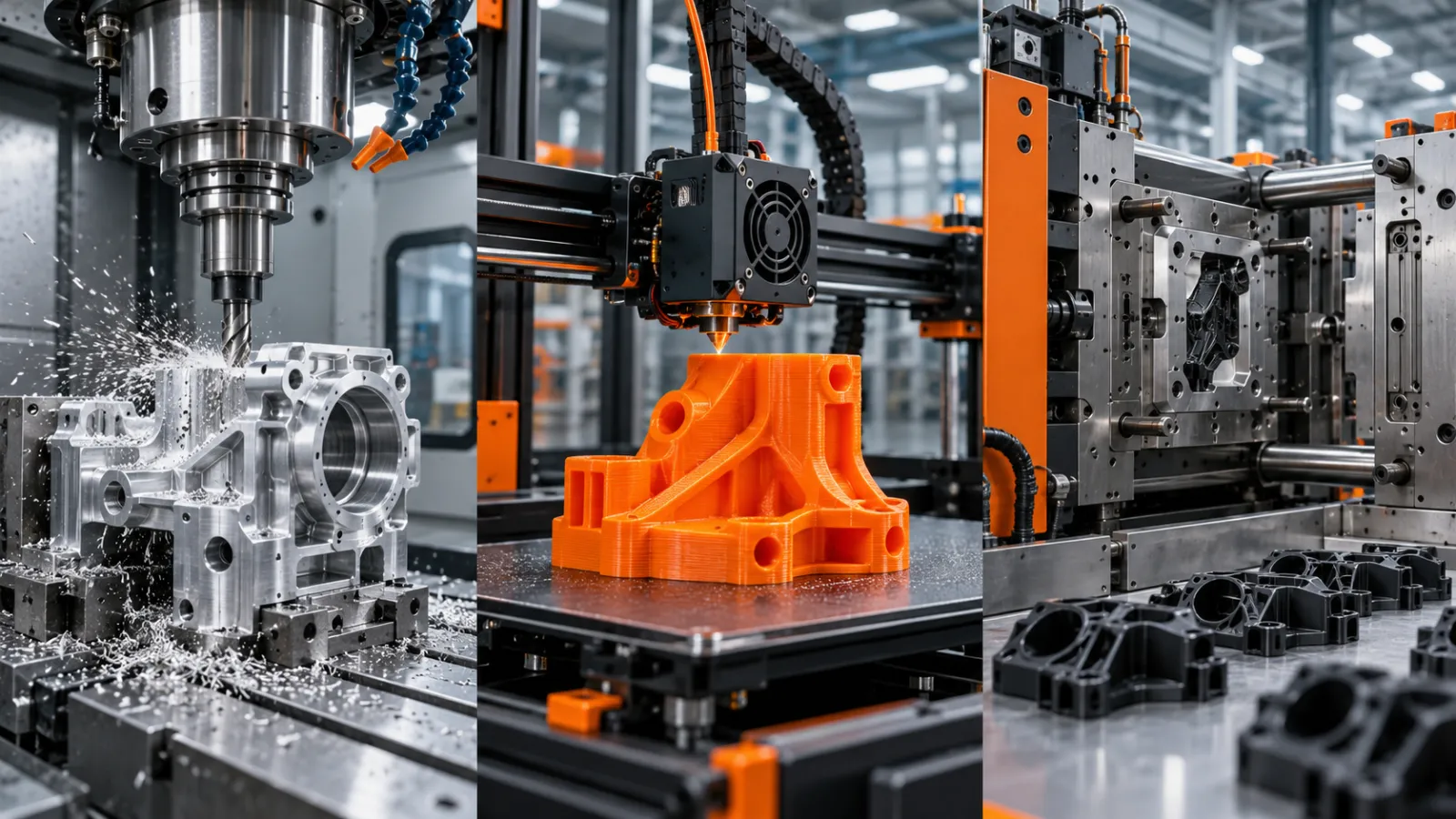
Quantity decides this more than anything else does: roughly 1–50 units points toward 3D printing, 1–500 toward CNC machining, and 500–1,000+ toward injection molding — and getting that threshold wrong is the single most common reason a part costs way more than it should.
Quick Summary
- 3D printing wins at very low quantities (1–50 units) and with complex, organic, or hard-to-machine geometry — no tooling cost, but per-unit price barely drops with volume.
- CNC machining is the sweet spot from roughly 1–500 units, with constant per-part cost, full material properties preserved, and the tightest achievable tolerances of the three.
- Injection molding only pays off once volume clears roughly 500–1,000+ units — the mold itself costs $3,000–$30,000+, but each part afterward is pennies to produce.
- A staged approach — 3D print to prototype, CNC to validate function, injection mold for final production — is standard practice, not a compromise.
- Material and geometry constraints differ sharply: CNC can't reach every internal cavity a printer can; molding needs draft angles and uniform walls that neither of the other two require.
What Actually Decides Which Process Is Right?
Quantity is the first filter, but it's not the only one. Geometry, material, tolerance, and timeline all push in their own direction, and the honest answer is usually "it depends on which of these your project cares about most."
How Many Units Do You Actually Need?
This is the cleanest signal available. 3D printing is most economical for 1–50 units — there's no tooling investment, but the cost per part barely improves as volume increases, since every part still gets printed individually. CNC machining works well from roughly 1–500 units — no tooling cost either, and the cost per part stays essentially flat regardless of quantity, since each part is cut independently from stock. Injection molding flips the model entirely: the mold itself is the large upfront cost, but once it exists, each part costs only material and a few seconds of cycle time — which is why it's uneconomical below roughly 500–1,000 units and dominant above it.
Does Geometry Rule Out Any of These?
Yes, in both directions. 3D printing has essentially no geometric limit — internal channels, organic curves, lattice structures, and undercuts that would be impossible to machine or mold are routine for a printer, because it builds up material layer by layer instead of removing or injecting it. CNC machining is constrained by tool access: a cutting tool has to physically reach every feature, so deep internal pockets, undercuts, and certain internal geometries are off the table or require multiple setups. Injection molding needs draft angles so the part can eject from the mold, plus reasonably uniform wall thickness to avoid warping and sink marks — design rules neither of the other two processes impose.
What About Material and Tolerance?
CNC machining preserves the full mechanical properties of the material, since the part is cut from solid stock rather than melted or built in layers — this matters a lot for metal parts and anything load-bearing. It also holds the tightest tolerances of the three, commonly down to a few thousandths of an inch, which makes it the right call for press fits, bearing bores, and anything that has to mate precisely with another part.
3D printing's tolerance is looser (commonly ±0.1–0.3mm) and mechanical properties can vary by print orientation, since layers bond to each other differently than a single solid piece of material would. Injection molding's tolerance depends heavily on material shrinkage during cooling — commercially typical tolerances run wider than CNC's — and it's genuinely the only one of the three that's a poor fit for tight-tolerance, precision-fit features regardless of how good the tooling is.
Which One Should Come First in a Product's Life?
Often more than one, in sequence. A common pattern: 3D print early concept models to check fit and form quickly and cheaply, move to CNC machining once the design needs to be functionally tested in the actual material, and only commit to injection molding tooling once the design is locked and the volume justifies the upfront mold cost. Treating these as complementary stages rather than competing choices avoids paying for injection tooling on a design that's still likely to change.
Frequently Asked Questions
Can I switch from 3D printing to CNC machining partway through a project without redesigning? Sometimes, but not always cleanly. A shape designed to take advantage of 3D printing's geometric freedom — deep internal channels, organic curves — may need real redesign to become machinable, since a cutting tool can't reach what a printer could build directly. It's worth planning the eventual production process early rather than assuming a printed prototype will translate directly.
Is injection molding ever worth it below 500 units? Occasionally, if the part is extremely simple and the mold is correspondingly cheap, or if a customer specifically needs the exact surface finish and material behavior that only molding produces. But as a general rule, below a few hundred units the upfront tooling cost rarely pencils out against CNC's zero-tooling, constant-per-part pricing.
Does 3D printing get cheaper at higher volumes the way molding does? Not much. Since each part is printed individually regardless of how many identical parts are queued, the per-unit cost stays relatively flat rather than dropping the way injection molding's does once the mold is paid off. This is exactly why 3D printing loses its cost advantage past small batch sizes.
Which process is best for a metal part that needs to bear real load? CNC machining, in almost every case. It preserves full material properties from solid stock, and while metal 3D printing exists, it's a specialized and typically more expensive route reserved for geometries that genuinely can't be machined any other way.
Not sure which of the three fits your part? Upload your design and we'll help you land on the right process for your quantity, material, and tolerance needs.
Written by James Wright, eMachineShop