
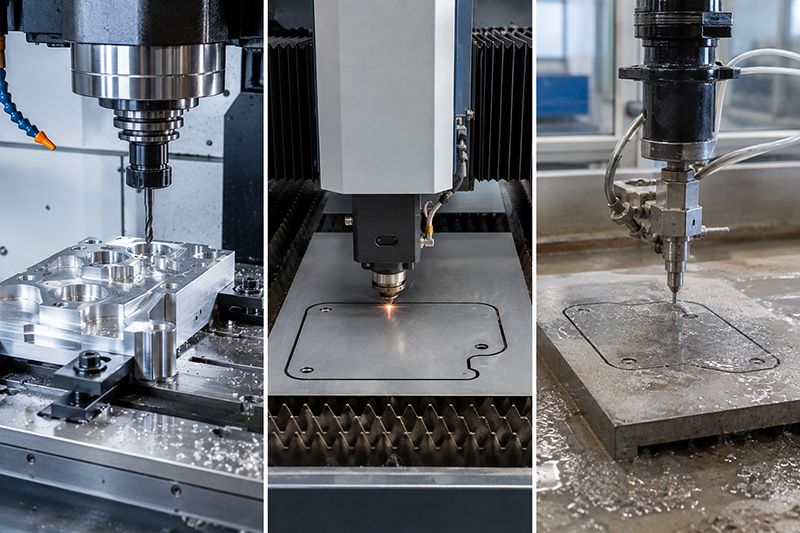
If your part is flat and 2D, laser or waterjet is often faster and cheaper than CNC. If it needs 3D features — pockets, threaded holes, contoured surfaces — CNC is usually the only option of the three.
Quick summary: Laser cutting is fastest and cheapest for thin sheet metal with simple 2D geometry. Waterjet handles thicker material and heat-sensitive metals without a heat-affected zone. CNC machining is required for any part needing 3D features, tight tolerances, or threaded holes.
When Is Laser Cutting the Right Call?
Thin sheet (typically under ½”), simple 2D profiles, high volume. Fast cycle times keep cost down, but laser introduces a heat-affected zone that can matter for some materials.
When Does Waterjet Make More Sense Than Laser?
Thicker material, heat-sensitive alloys (titanium, some stainless grades), or parts where a heat-affected zone isn’t acceptable. Waterjet is slower than laser but avoids thermal distortion entirely.
When Do You Actually Need CNC?
Any 3D feature — a pocket, a counterbore, an internal thread — takes CNC out of “one of three options” and into “the only option.” Laser and waterjet are 2D-cutting processes; CNC is not.
Can These Processes Be Combined?
Often, yes — a part can be laser-cut or waterjet-cut to a rough profile, then CNC-finished for tight-tolerance features. This can be cheaper than machining the whole part from solid stock.
FAQ
Is waterjet always more expensive than laser? Usually, per part — but not always per project, especially on thick or heat-sensitive material where laser would introduce distortion.
Can laser cutting hold tight tolerances? Not to CNC-level tolerances on most materials — laser is better suited to profile cutting than precision fit features.
Related: Laser Cutting Services · Waterjet Cutting Services