
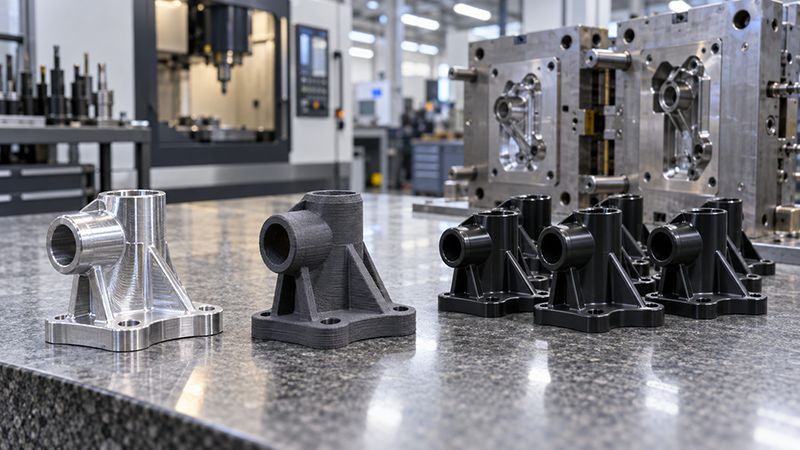
The process that’s right for one prototype is often the wrong process for 5,000 units — and the reverse is just as true. Knowing when to switch is a cost decision, not a maturity milestone.
Quick summary: CNC machining and 3D printing dominate prototyping because they require no tooling investment. Injection molding and other tooled processes dominate production because per-unit cost drops dramatically once tooling is amortized — but only past a volume threshold that justifies the tooling cost.
Why Is CNC or 3D Printing Usually Right for Prototypes?
No tooling investment. You can iterate a design multiple times without paying for a mold each time you change a feature.
Why Does Injection Molding Take Over at Higher Volumes?
Mold tooling is expensive upfront, but the per-unit cost afterward is very low. Past a certain volume, that trade pays for itself — often faster than most people expect.
How Do You Know When You’ve Crossed the Threshold?
Compare total cost at your expected volume: CNC/3D print cost scales roughly linearly per unit; injection molding has a large fixed cost plus a low variable cost. The crossover point depends on part complexity and material, but it’s a calculable number, not a guess.
What Happens If You Switch Processes Too Early or Too Late?
Switching to tooling too early risks paying for a mold before the design is finalized — expensive if it changes. Staying on CNC too long into production means paying a higher per-unit cost indefinitely.
FAQ
Can a design go straight from sketch to injection molding, skipping CNC prototyping? Technically yes, but it’s risky — any design flaw discovered after the mold is cut is expensive to fix.
Is there a hybrid approach? Yes — some programs use CNC-machined “bridge tooling” to produce a few hundred units while production tooling is still being built.
Related: Injection Molding Services