
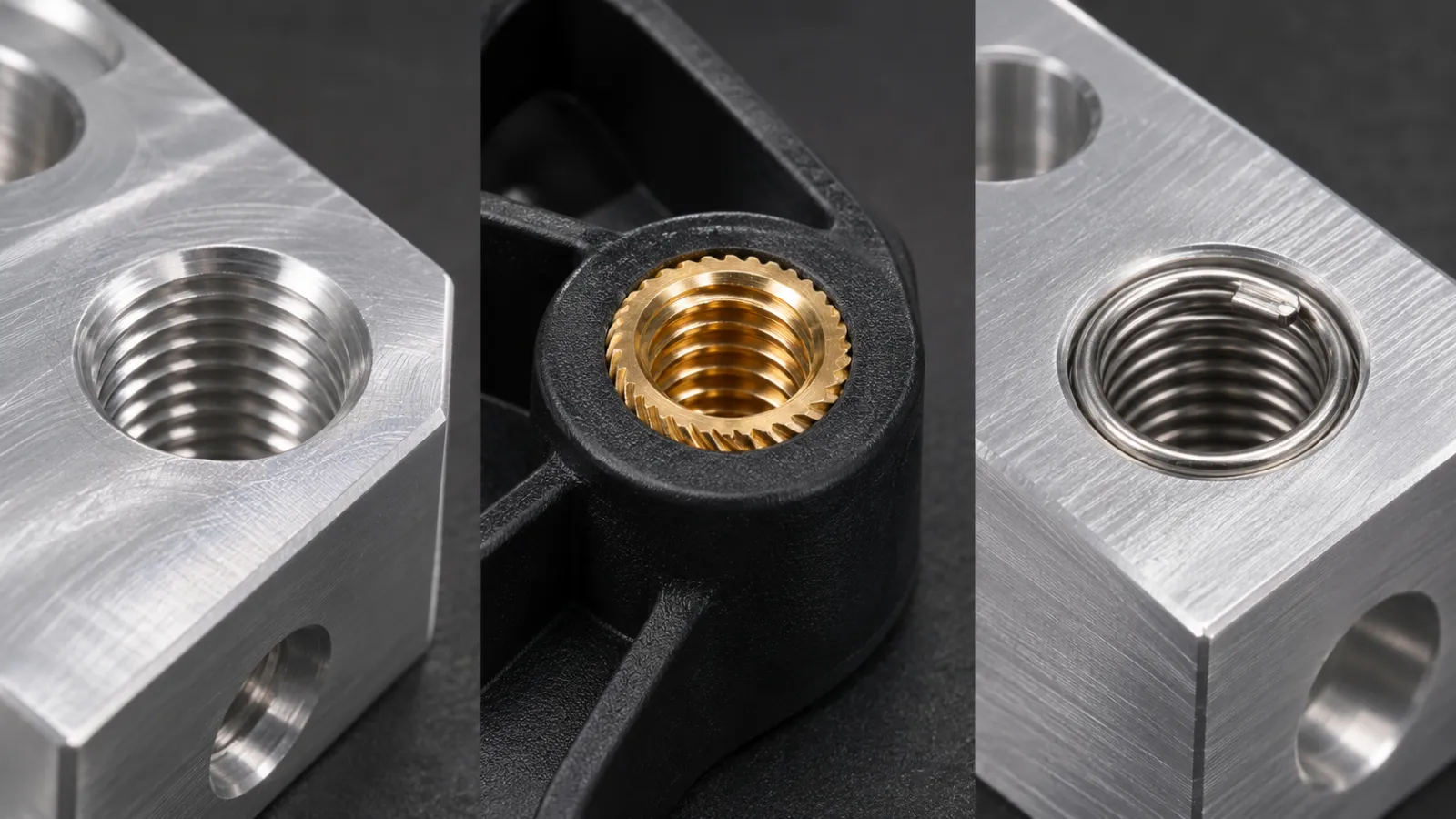
Tapping is the cheapest and simplest way to put a thread in a part, and it's the wrong answer the moment the assembly gets taken apart more than a handful of times or the base material is too soft to hold up on its own.
Quick Summary
- Tapped holes cut threads directly into the part material — cheapest option, but threads in soft metals like aluminum can gall or strip under repeated assembly.
- Heat-set inserts are melted into plastic (typically with a soldering iron or ultrasonic horn), giving plastic parts a durable metal thread that outlasts the plastic itself.
- Helicoils are coiled wire inserts screwed into an oversized tapped hole — the standard fix for stripped or unreliable threads in aluminum, and the default choice in aerospace assemblies.
- A print calling out a thread should specify the standard, class, and depth explicitly (e.g., "1/4-20 UNC 2B x 0.500 MIN FULL THREAD") — leaving any of that off invites ambiguity the same way a vague tolerance callout does.
- Minimum thread depth in aluminum is roughly two times the nominal thread diameter; going shallower risks stripping under normal torque.
When Is a Plain Tapped Hole the Right Call?
When the part material is hard enough to hold threads on its own — steel, most stainless grades, hard aluminum alloys under light duty — and the assembly won't be taken apart more than 10–20 times. Tapping is the cheapest threading method available, works with standard thread sizes and pitches, and needs no secondary hardware. If cost is the top priority and the design doesn't ask for anything unusual, a tapped hole is usually the right default.
When Does a Tapped Hole Start to Fail?
Two situations cause most of the problems: soft base material, and repeated assembly cycles. Aluminum and plastic threads deform a little every time a screw is driven in and backed out — eventually the ridges that grip the screw wear down to nothing, and the hole no longer holds torque. This shows up as a screw that spins freely instead of tightening, usually after fewer disassembly cycles than anyone expected.
What Are Heat-Set Inserts, and When Are They the Right Fix?
A heat-set insert is a small metal sleeve, usually brass, with external knurling and an internal machine thread. It's melted into a plastic part — with a soldering iron for one-off or low-volume work, or ultrasonically for production — so the surrounding plastic reflows around the knurled exterior and locks the insert in place once it cools. This gives a plastic part a genuinely durable metal thread instead of relying on the plastic itself to hold up under repeated screwing.
The design rules matter here: the hole needs to be sized to the insert's specific knurl diameter (guessing causes loose or split parts), the surrounding wall or boss should run roughly two to three times the insert's diameter so it doesn't crack during installation, and the hole should be a little deeper than the insert itself so there's somewhere for displaced material to go.
What's a Helicoil, and Why Does Aerospace Default to It?
A helicoil is a coil of diamond-section wire, screwed into a specially oversized and tapped hole, that forms a smooth, hard, precision internal thread. Instead of the screw bearing directly against the parent material, it bears against the coil — which spreads load across more threads and resists the galling and stripping that plague tapped aluminum specifically. It's also a legitimate repair option: a stripped tapped hole can often be re-tapped oversized and fitted with a helicoil to restore it to its original thread size, rather than scrapping the part.
This is why helicoils show up constantly in aerospace and aluminum structural work — repeated assembly and disassembly over a part's service life is the norm, not the exception, and a coil designed to spread load survives that far better than aluminum threads cut directly into the part.
What Actually Belongs on the Thread Callout?
Beyond deciding which threading method to use, the print needs a complete callout: thread size and pitch, standard (UNC, UNF, or metric), tolerance class, and minimum thread depth or engagement length. "1/4-20 UNC 2B x 0.500 MIN FULL THREAD" tells a machinist everything needed; "tap for 1/4-20 screw" leaves the depth and class up to interpretation, which is exactly the kind of ambiguity that causes a part to come back wrong.
Frequently Asked Questions
How deep does a tapped hole need to be? In aluminum, roughly two times the nominal thread diameter as a minimum — a 1/4-20 thread needs at least 0.500" of engagement. Going shallower risks the threads stripping under normal torque, since there isn't enough engaged thread to distribute the load.
Can a stripped tapped hole be fixed without scrapping the part? Often, yes — re-tap the hole to the next standard oversize and install a helicoil or similar thread insert. This is a standard field and shop repair, not a workaround of last resort.
Do heat-set inserts work in metal parts, or only plastic? Only plastic. The whole mechanism depends on the surrounding material melting and reflowing around the insert's knurled exterior — metal doesn't do that. Metal parts needing a durable insert use helicoils or a similar mechanically-driven insert instead.
Is a helicoil stronger than a plain tapped thread in the same material? For repeated assembly cycles, yes, meaningfully. The coil spreads load across more thread engagement and resists the wear pattern that causes plain aluminum threads to gall and loosen over time — which is exactly why aerospace assemblies default to it rather than tapping directly into structural aluminum.
Need help specifying the right threading method for a part? Our Unified Thread Standard reference covers UNC, UNF, and UNEF sizing, or upload your drawing and we'll help you land on the right callout.
Written by James Wright, eMachineShop