
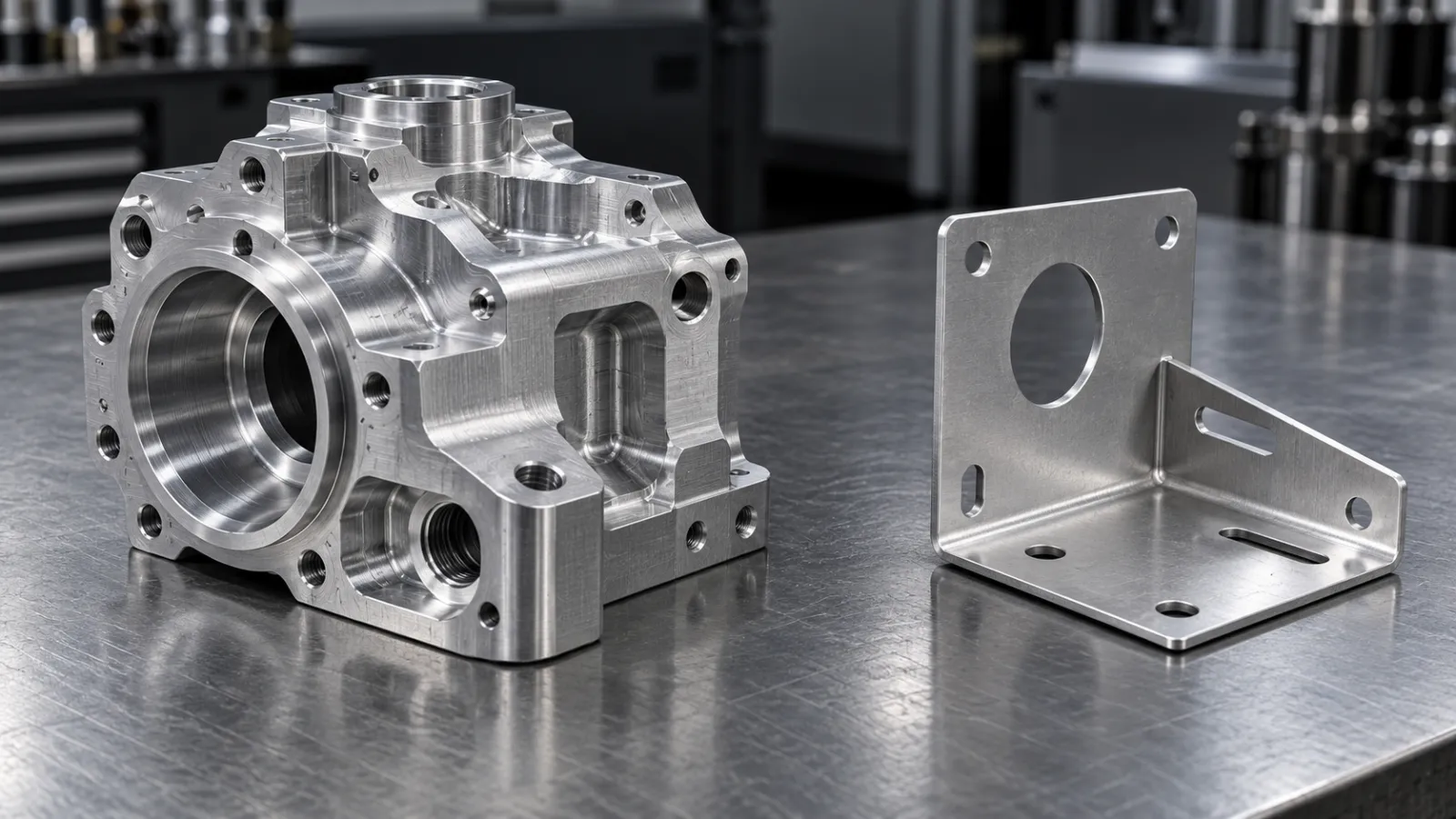
Once a part is mostly flat, mostly the same thickness, and doesn’t need tight 3D tolerances, sheet metal fabrication almost always beats CNC on cost — sometimes dramatically.
Quick summary: CNC machining removes material from solid stock, which costs more in both raw material and machine time than forming or cutting sheet metal to shape. The crossover point is usually geometry-driven: flat, simple parts favor sheet metal; complex 3D parts favor CNC regardless of cost.
Why Is Solid-Stock Machining More Expensive by Default?
CNC starts with a block and removes everything that isn’t the part — that’s wasted material and machine time. Sheet metal starts close to final thickness and is cut or formed to shape, wasting far less material.
What Kind of Part Favors Sheet Metal?
Enclosures, brackets, panels — anything that’s essentially a flat shape with bends, punched holes, or simple cutouts. These are sheet metal’s core strength.
What Kind of Part Still Needs CNC, Regardless of Cost?
Parts with 3D pockets, precision bores, or tight positional tolerance on machined features. Sheet metal can’t replicate that geometry no matter how the cost comparison shakes out.
Is There a Volume Threshold That Changes the Answer?
At very high volumes, other processes (stamping, injection molding) may beat both — but between CNC and sheet metal specifically, the crossover is almost always about geometry, not quantity.
FAQ
Can a part be partly sheet metal and partly CNC? Yes — sheet metal weldments are sometimes CNC-finished at critical mounting features, combining both processes.
Is sheet metal less precise than CNC? Generally yes for tight tolerances, though modern sheet metal fabrication (laser-cut, precision-formed) can hold reasonably tight tolerances on flat features.
Related: Sheet Metal Fabrication