
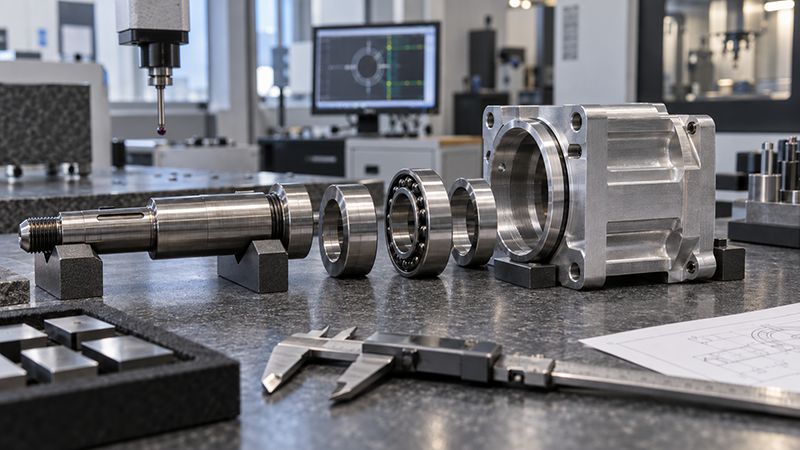
Every individual part can measure perfectly within its own tolerance and the assembly still won’t go together — because tolerance stack-up isn’t about whether any one part is correct, it’s about what happens when several correct parts’ tolerances compound in the same direction.
Quick Summary
- Tolerance stack-up is the cumulative variation that builds up across a chain of mating dimensions in an assembly, not the tolerance on any single part.
- Every part in the stack can be perfectly in-spec on its own and the assembly can still fail to fit, if the tolerances happen to compound in the same direction.
- Worst-case stack-up analysis (adding every tolerance at its limit) is the most conservative approach; statistical methods (like root-sum-square) reflect real-world variation more realistically but require more analysis.
- The more parts in a mating chain, the more the stack-up matters — a two-part assembly is a much smaller risk than a five-part stack.
- GD&T with proper datums, rather than a chain of independent linear tolerances, is one of the most effective ways to control stack-up directly.
What Is Tolerance Stack-Up, Actually?
When several parts mate together — a shaft through a series of spacers into a housing, for instance — each part’s individual tolerance contributes to the total variation in the final assembled dimension. If every part in that chain happens to land at the high end of its tolerance range, the total variation can be significantly larger than any single part’s tolerance alone, even though every part individually passed inspection. eMachineShop’s own mating parts guidance puts the core rule plainly: the lowest possible dimension of the female part needs to stay greater than the largest possible dimension of the male part, accounting for both parts’ tolerance ranges at once, not just their nominal sizes.
Why Can an Assembly Fail Even Though Every Part Is In-Spec?
Because “in-spec” only guarantees that one dimension falls inside its own tolerance band — it says nothing about how that variation interacts with the variation in the next part, and the part after that. A five-part stack where each part is off by a few thousandths in the same direction can add up to a gap or interference that no individual inspection would catch, because no individual part actually failed its own inspection.
What’s the Difference Between Worst-Case and Statistical Stack-Up Analysis?
Worst-case analysis assumes every part in the chain lands simultaneously at its tolerance limit, in the direction that makes things worst — it’s the most conservative approach and guarantees the assembly works even in an unlikely worst case, but it can force tighter, more expensive tolerances than statistically necessary, since that exact worst-case combination is often statistically rare. This is exactly why it’s worth knowing what the standard default tolerance actually is before assuming every part needs a custom, tighter spec — the baseline is often adequate for most of the parts in a stack, with only the true fit-critical dimensions needing anything tighter.
Statistical methods, like root-sum-square, instead treat each part’s variation as following a distribution and calculate the likely combined variation rather than the absolute worst case. This usually allows for looser, cheaper individual tolerances while still keeping the assembly reliable in the vast majority of real cases — the tradeoff is that a small percentage of assemblies could theoretically still fail, which needs to be an acceptable risk for the application.
How Does the Number of Parts in the Chain Change the Risk?
Directly and significantly. A two-part mating interface has a much smaller stack-up risk than a five-part chain, simply because there are fewer tolerances compounding. This is one of the underappreciated reasons to consolidate parts in an assembly where possible — fewer mating interfaces means fewer opportunities for tolerances to compound into an interference or gap problem.
How Does GD&T Help Control This?
A chain of independent linear tolerances lets each part’s dimension wander independently, with no explicit control over how features relate to each other across the assembly. GD&T, properly applied with clear datums, controls the relationship between features directly — position, concentricity, parallelism relative to a shared reference — which constrains how the variation can combine rather than leaving every part free to drift independently in whatever direction its own tolerance allows. Every dimension having a tolerance, and tolerances applying to the full length of a feature rather than just a sample point, are foundational GD&T rules that exist specifically to close the ambiguity gaps a plain linear-tolerance chain leaves open.
Frequently Asked Questions
Does tolerance stack-up only matter for precision assemblies? No — it applies to any assembly with more than one mating part, though the consequences are more visible in precision work. A loose consumer product might absorb some stack-up without anyone noticing; a bearing assembly or optical mount won’t.
Is a tighter tolerance on every part in the chain always the safest fix? It’s the most conservative fix, but not always the smartest one. Tightening every part’s tolerance drives up cost across the whole chain; a stack-up analysis often reveals that only one or two dimensions in the chain actually need to be tightened to solve the problem, while the rest can stay at standard tolerance.
How do I know if my assembly needs a formal stack-up analysis rather than just tolerancing each part reasonably? If the assembly has three or more mating parts in a critical dimensional chain, or if a failure to fit would be expensive or unsafe, a formal analysis is worth the time. For a simple two-part interface with generous clearance, reasonable individual tolerancing is often sufficient without formal analysis.
Can a stack-up problem be fixed after parts are already made, or does it require a redesign? Sometimes a shim, spacer, or adjustable feature can absorb the accumulated variation without redesigning the mating parts themselves — this is a common practical fix. But it’s cheaper by far to catch the stack-up risk during design than to add a compensating feature after parts are already in production.
Working through a multi-part assembly and want a second opinion on where tolerance stack-up might bite? Upload your drawings and we can talk through the mating dimensions before they’re locked in — our pre-order checklist and cost-reduction guide are both worth a pass first, since “use the loosest applicable tolerance” is exactly the instinct that keeps a multi-part stack-up problem from becoming a multi-part cost problem too.
Written by James Wright, eMachineShop